
AI & Future
LSTM for Share Market Prediction: Use It Wisely
Editor | February 28, 2026 | 5 min read
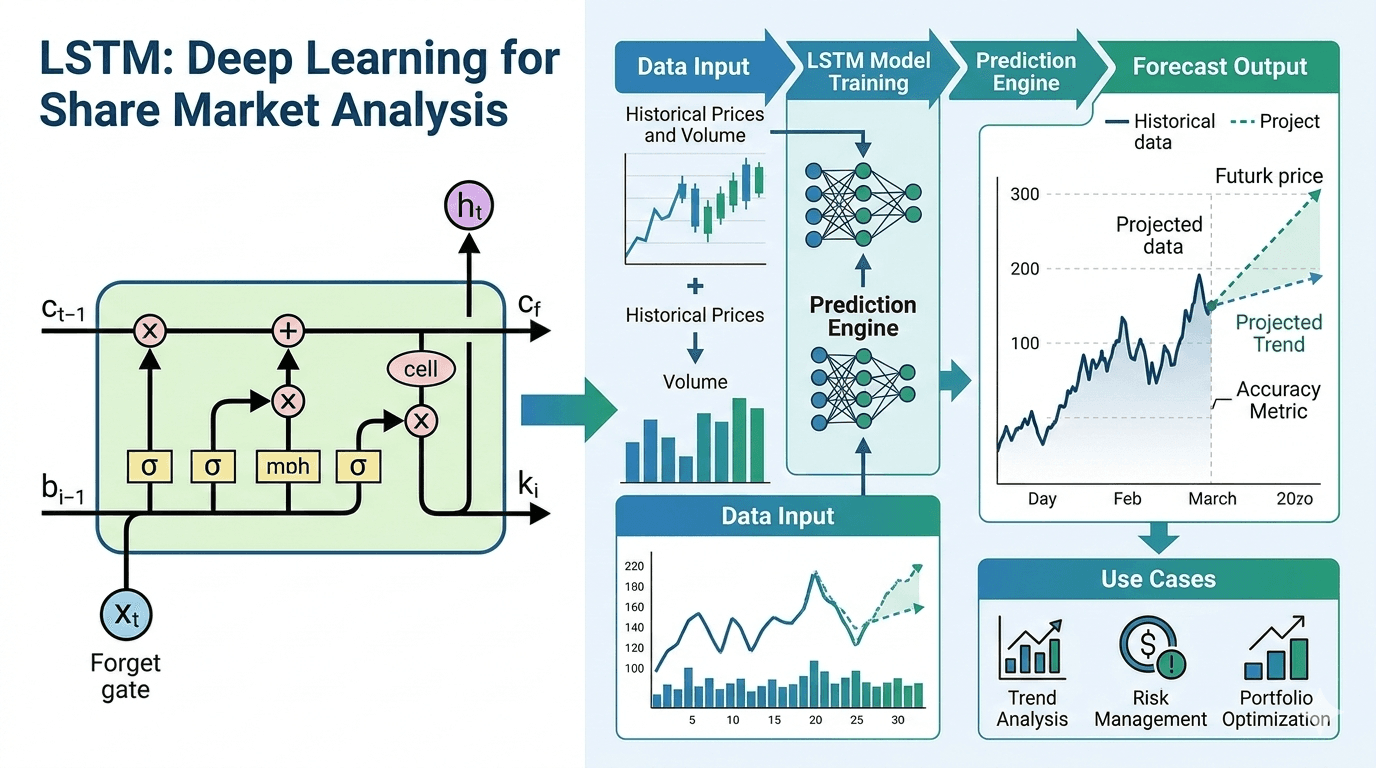
LSTM models are popular for share market prediction because they can learn patterns from sequential data. But using LSTM naively often leads to overfitting, data leakage, and unrealistic backtests.
If you want useful outcomes, treat LSTM as one component in a full trading research pipeline, not a magic predictor.
Where LSTM Helps
- modeling temporal patterns in price/volume sequences
- combining multiple time-series features (returns, volatility, indicators)
- learning non-linear relationships that linear models may miss
Where It Fails in Real Trading
- market regimes change; old patterns stop working
- training leakage gives fake high accuracy
- prediction quality can be too weak after fees and slippage
- direction accuracy alone is not enough for profitability
Wise Setup: Practical Checklist
- Predict returns, not raw price.
- Split data by time (never random split).
- Use walk-forward validation, not one fixed train/test split.
- Include transaction cost and slippage in backtests.
- Compare against simple baselines (buy-and-hold, moving-average, linear model).
- Track trading metrics, not just ML loss.
Minimal Pipeline
# 1) Build features from past-only data
# 2) Create rolling windows for LSTM input
# 3) Train on historical segment
# 4) Validate on next unseen segment
# 5) Roll forward and repeat
# 6) Backtest strategy with fees/slippage
Example Keras Skeleton
from tensorflow.keras.models import Sequential
from tensorflow.keras.layers import LSTM, Dense, Dropout

model = Sequential([
    LSTM(64, return_sequences=True, input_shape=(lookback, n_features)),
    Dropout(0.2),
    LSTM(32),
    Dense(1)  # next-step return
])

model.compile(optimizer="adam", loss="mse")
model.fit(X_train, y_train, epochs=20, batch_size=32, validation_data=(X_val, y_val))
Metrics That Matter
Use model metrics and trading metrics together:
- RMSE/MAE on returns
- directional accuracy
- Sharpe ratio
- max drawdown
- win rate
- profit factor
If trading metrics are weak, a low validation loss does not help.
Risk Management Is Non-Negotiable
- cap position size
- use stop-loss / volatility-based exits
- avoid over-concentration in one stock
- pause model when performance degrades out-of-sample
Final Take
LSTM can be useful for market prediction research, but only with strict time-aware validation and realistic backtesting. The wise approach is:
- start simple
- benchmark hard
- assume regime change
- control risk first
Use LSTM to support decisions, not to blindly automate capital deployment.